Stability of a numerical method - general definition
- - Classical stability of a method studied on \(u'(t)=\lambda\,u(t)\), \(\lambda\in\mathbb{C}\).
-
- - The true solution \(\tilde u(t)=\exp(\lambda\,t)\) converge if \(\mathbb{R}_e(\lambda)\leq 0\).
- - For linear system, \(\lambda\) refers to eigenvalues of \(\mathrm{A}\).
- - For non linear system, \(\lambda\) refers to eigenvalues of the Jacobian of \(\mathcal{F}\)
- - A numerical method is unconditionnaly stable if \(\mathbb{R}_e(\lambda) \leq 0\)
-
- \(\Rightarrow\) stable discrete solution.
- - Otherwise, it is conditionnally stable/unstable.
- - Region of stability:
-
- Set of conditions on \(\lambda\) such that the discrete solution doesn't diverge.
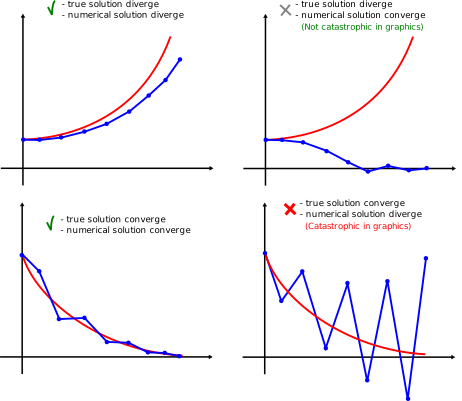
- - A numerical solution can diverge even when the true ODE solution converge when using unstable numerical method.
- - Converseley, a numerical solution can converge even when the true ODE solution diverge when using stable numerical method.
- - Stability \(!=\) Accuracy.