- Attention, l'ordre des opérations est important !
-
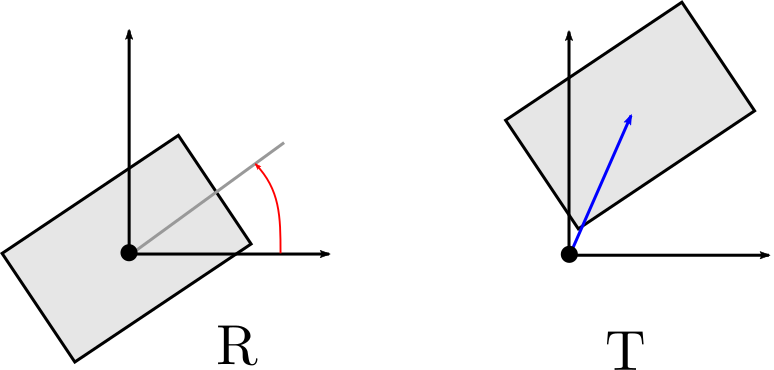
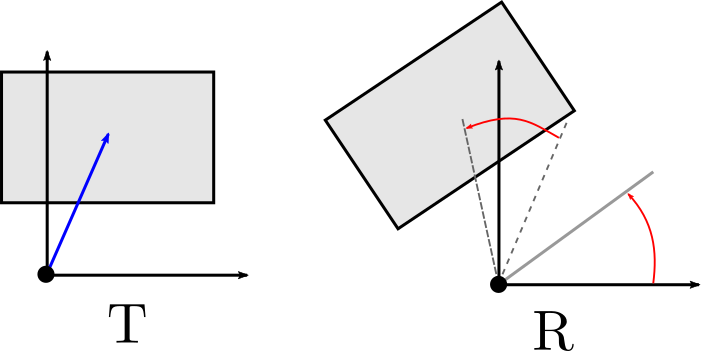
- Rotation \(r\), Translation \(t\): \(\;\;r\circ t \neq t\circ r\) \(\;\;\Rightarrow\; \mathrm{M}_1= \mathrm{T}\,\mathrm{R} \;\neq\; \mathrm{R}\,\mathrm{T} = \mathrm{M}_2\)
- Attention (2) : les matrices de transformation sont appliquées aux coordonnées de droite à gauche.
- \(\mathrm{M}_1=\mathrm{T}\mathrm{R}=\left(\begin{array}{c|c} 1 & t \\ \hline 0 & 1 \end{array}\right)\,\left(\begin{array}{c|c} R & 0 \\ \hline 0 & 1 \end{array}\right) = \left(\begin{array}{c|c} R & t \\ \hline 0 & 1 \end{array}\right)\)
- D'abord rotation, puis translation
- \(\mathrm{M}_2=\mathrm{R}\mathrm{T}=\left(\begin{array}{c|c} R & 0 \\ \hline 0 & 1 \end{array}\right)\,\left(\begin{array}{c|c} 1 & t \\ \hline 0 & 1 \end{array}\right) = \left(\begin{array}{c|c} R & \mathrm{R}\,t \\ \hline 0 & 1 \end{array}\right)\)
- D'abord translation, puis rotation
-
- La rotation se fait toujours autour de l'origine.
Attention : Certaines bibliothèques (ancien OpenGL, Three.js)
appliquent les transformations de "gauche à droite" en utilisant une multiplication matricielle transposée
appliquent les transformations de "gauche à droite" en utilisant une multiplication matricielle transposée