Objective
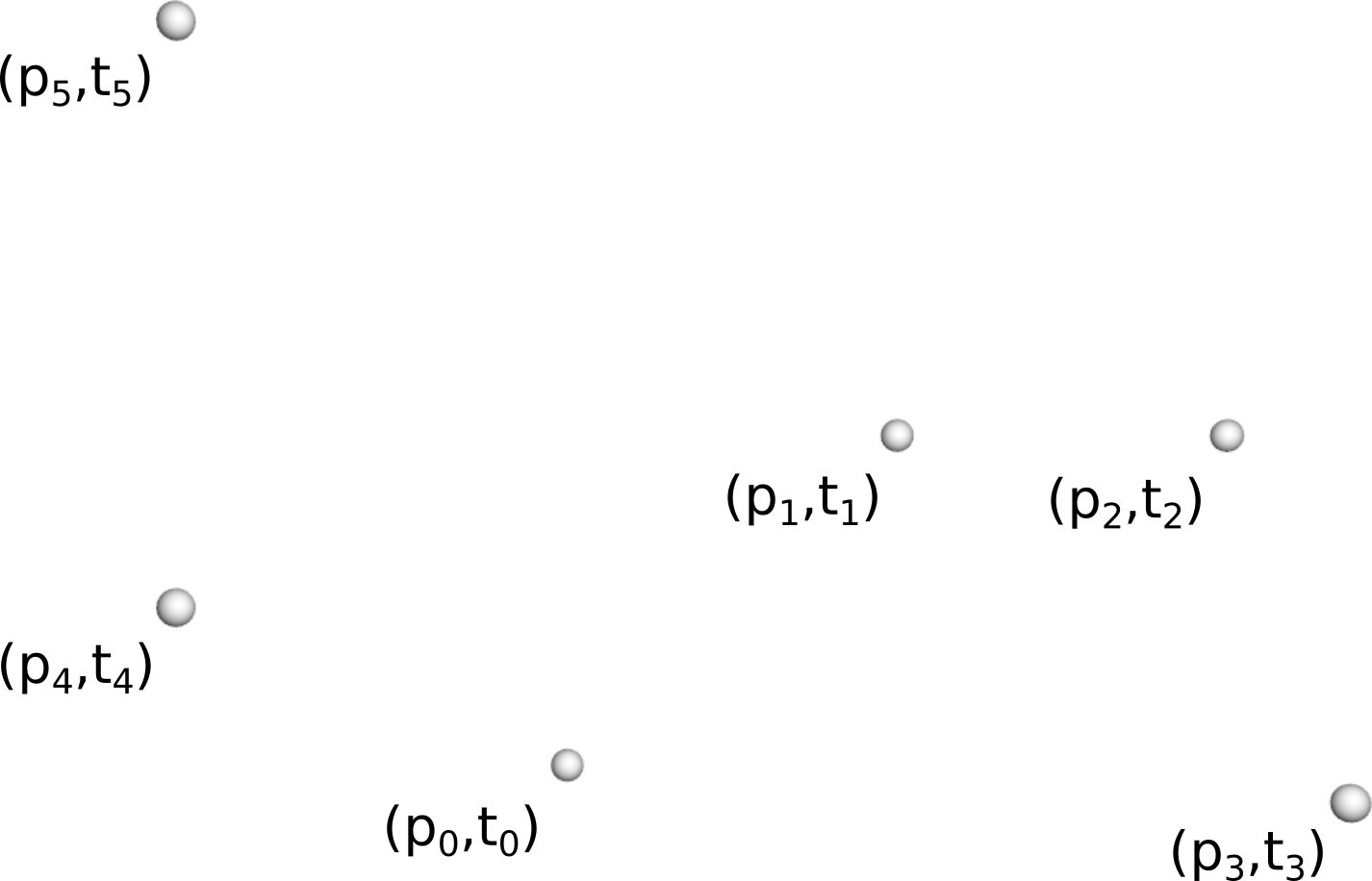
- Given a set of key-positions (positions+time) we want to find an interpolating space-time curve
-
Input
\((p_i,t_i), i \in [0,N-1] \)
-
Output
- Space time curve \(p(t), t\in[t_0,t_{N-1}]\)
- Space time curve \(p(t_i)=p_i\)
3/47
1 - Keyframe interpolation
2 - Interpolate positions
3 - Objective
4 - Linear Interpolation
5 - Smooth curve
6 - Lagrange polynomial interpolation
7 - Lagrange polynomial interpolation : Comparison
8 - Spline
9 - Hermite interpolation
10 - Interpolating curve
11 - Wrap-up Algorithm
12 - Limitation of cubic curve interpolation
13 - Usage of keyframes interpolation
14 - Multi-target blending and blend shapes
15 - Curve editing
16 - Interpolate rotations
17 - Rotation
18 - Rotation in 2D: Easy
19 - Rotation in 3D - DOF
20 - Representing 3D Rotations
21 - Rotation representation: Matrix
22 - Representing 3D Rotations
23 - Rotation representation: Euler angles
24 - Rotation representation: Euler angles
25 - Representing 3D Rotations
26 - Rotation representation: Axis-Angle
27 - Rotation representation: Axis-Angle
28 - Axis-Angle as matrix
29 - Rotation representation: Axis-Angle
30 - Composition between axis angle representation
31 - Representing 3D Rotations
32 - Intuition for quaternion
33 - Big picture of quaternions
34 - Rotation representation: Quaternions
35 - Basics operations on quaternions
36 - Relation between quaternion and rotation
37 - Composition of rotations
38 - Correspondance quaternion to rotation matrix
39 - Summary - Correspondance quaternion / matrix-vector
40 - Interpolation of Quaternion - LERP
41 - Interpolation of Quaternion - SLERP
42 - Interpolation of Quaternion - SLERP
43 - Care with quaternion negation
44 - Interpolating rigid motion
45 - Interpolating rigid motion - Comparison
46 - Handling affine transformation : Polar Decomposition
47 - Handling affine transformation