Dual quaternion
- Given a quaternion \(q_0\) and a translation \(t\), its associated dual quaternion is
-
- \(\displaystyle \hat q=q_0 + \frac{\epsilon}{2} q_t\,q_0\), \(q_t=(t_x,t_y,t_z,0)\)
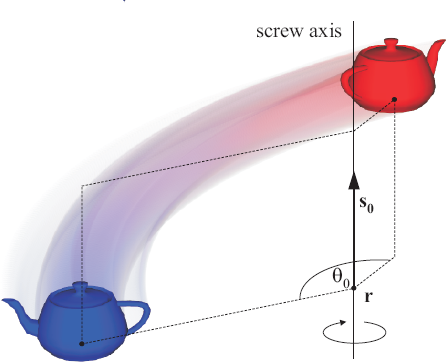
- Similarily to quaternion: angle/axis correspondance
-
- - \(\displaystyle \hat q=\cos(\hat \theta/2)+ \hat n \sin(\hat \theta/2) \)
-
- - \(\hat \theta=\theta_0 + \epsilon \theta_{\epsilon}\)
-
- - \(\theta_0\): angle of rotation
- - \(\theta_{\epsilon}=t\cdot n_0\;\): amount of translation along \(n_0\)
-
- - \(\hat n=n_0+\epsilon\,n_{\epsilon}\)
-
- - \(n_0\): axis of rotation
- - \(n_{\epsilon}=\frac{1}{2}\left( (n_0 \times t)\, \mbox{cotan}(\theta_0/2)+t\right) \times n_0\): called the moment of the rotation axis.
35/41